

| MUST History at a Glance
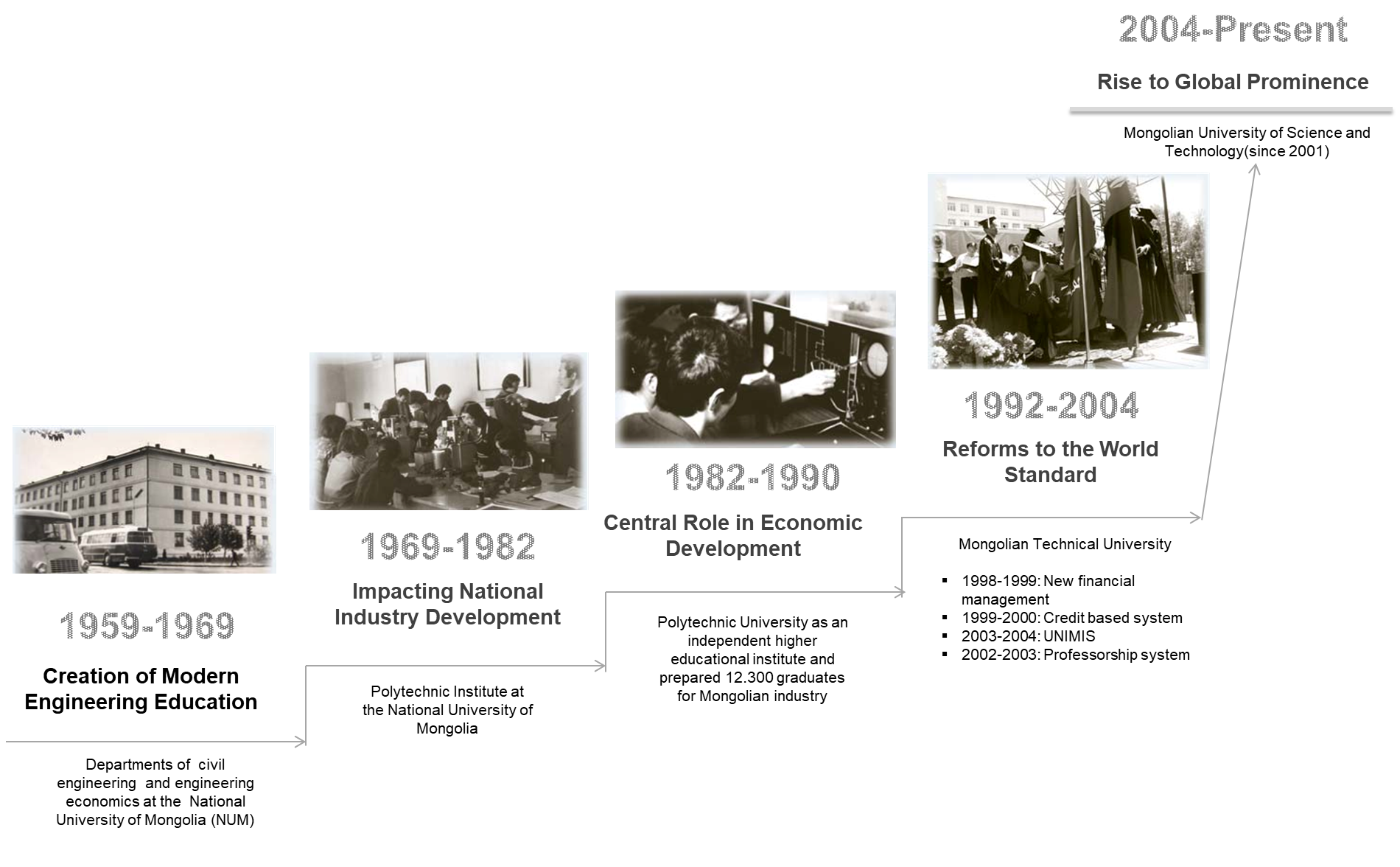
In the 1960s, Mongolia set out to transform itself into an industrial-agricultural country. To achieve this goal and develop a domestic workforce of engineers and technical specialists, the National University of Mongolia (NUM) began training specialists in Industrial Economics and Civil Engineering in 1959, followed by Geological Engineering in 1960.
As the number of qualified academic staff in engineering and technical fields gradually increased, the Polytechnic Institute (PI) was established within NUM in 1969. It initially comprised five faculties: Civil Engineering, Power Engineering, Geology and Mining, Mechanical Engineering, and Engineering Economics, with a total of 13 academic departments.
In 1970, the UNESCO MON-1 Project was launched, contributing to the development of a new generation of academic staff and the establishment of an adequate material and technical infrastructure for education. As the Polytechnic Institute continued to develop and strengthen its institutional capacity, it was separated from NUM and reorganised as an independent higher education institution in 1982, pursuant to a resolution of the Council of Ministers of the Mongolian People's Republic (MPR).
Following the democratic transition and reforms in Mongolia, the country's higher education system underwent significant restructuring. As part of the efforts to strengthen the national education system, higher education institutions were upgraded to university status, with expanded institutional authority and autonomy. These changes were implemented in accordance with Resolution No. 154 of the Council of Ministers of the Mongolian People's Republic, adopted in 1990.
The Technical University took a leading role in modernising Mongolia's higher education system and advancing democratic reforms. It consistently introduced the credit-based education system and restructured its academic activities in accordance with democratic principles. Furthermore, the university adapted its organisational structure to the requirements of a market economy by introducing a system based on schools, professorial teams, and research centres.
During this period, the Technical University's international relations expanded significantly, enabling it to become part of international university networks. As a result of these institutional reforms and continued development, the Technical University evolved into what is now known as the Mongolian University of Science and Technology (MUST).
In 2013, MUST initiated a new phase of institutional reforms aimed at further strengthening the university and transforming it into a research university.
To achieve this objective, the university began pursuing a comprehensive development strategy focused on aligning its institutional structure with international standards, significantly improving the quality of education, increasing the number of internationally recognised academic staff, and expanding the scope and impact of its research activities. The strategy also emphasised promoting innovation and enhancing the university's international competitiveness, with the ambitious goal of securing a place among Asia's top 200 universities.